South African producers are under considerable pressure, as both local and global factors are weighing on local companies.
In particular, United States tariffs on South African imports present a significant threat to local companies, but this impact is heightened by domestic pressures that make local goods less competitive.
This is feedback from Nedbank chief economist Nicky Weimar, who recently spoke at the 2025 Nedgroup Investments Treasurers’ Conference.
Weimar explained that local producers face an uphill battle, especially in light of the United States’ new tariff policy.
In August 2025, the United States implemented a 30% tariff on South African goods, which is set to affect an estimated 52% of the country’s products.
“The sad bit is that the bit that will be most significantly affected is your higher value-added type manufacturing,” Weimar said.
They are the ones who benefited the most from the AGOA. They are the ones that benefited the most from access into the US, and that is now gone.”
“And unfortunately, this, for South Africa’s producers and exporters, will mean a hit.”
To make matters worse, this comes against a background where South Africa’s producers and exporters are already facing cost challenges.
South Africa is already not known to be a low-cost producer, meaning the country’s producers must find innovative ways to try and stay competitive.
However, this is a tough ask, as a lot of the costs that go into producing emanate from the country’s inefficiency and lack of investment in infrastructure.
Weimar explained that South Africa’s lack of fixed investment, particularly investment in infrastructure, is one of the main impediments to accelerating the country’s growth.
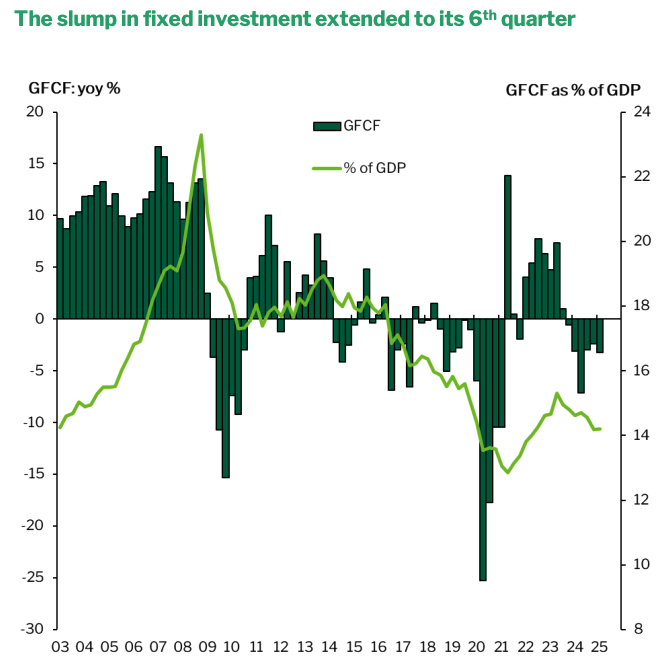
Despite promises from the Government of National Unity (GNU) to significantly boost fixed investment, there is no evidence of recovery in this regard, with gross fixed capital formation (GFCF) still far below levels needed to make a meaningful contribution to economic growth.
Fixed investment slump

Nedbank chief economist Nicky Weimar
The GNU has committed R1 trillion towards infrastructure spending over the next five years.
However, in the second quarter of 2025, fixed investment in South Africa recorded its sixth consecutive quarter of decline.
Weimar said the government’s priorities are in the right place, as they plan to focus this spending on logistics, energy, and water.
This is mainly because much of this funding will be allocated through South Africa’s public enterprises, which do not have the best track record for efficient and productive spending.
For example, while Transnet has made some progress in its recovery, rail freight remains far below the utility’s best average levels, and containment processing remains poor.
Transnet’s poor performance means many South African producers are still reliant on trucking to transport goods, which is a very inefficient and expensive way to move freight.
Weimar pointed out that, aside from cost, local producers also face a high regulatory burden, with South Africa having the highest regulatory burden among all the countries surveyed by the OECD.
“So, the problem is for our producers, it’s gonna be an uphill battle. An absolute uphill battle,” she said.
“They now face a more hostile global environment. They have to deal with the 30% tariff, which is much higher than the tariff many other countries have placed on them and our competitors.”
“They’re facing the prospect of weaker global growth. Plus, they’re still trying to contend with high domestic cost structures. So, in our opinion, the pressure on production will continue.”
Weimar said this pressure on local producers will have implications for fixed investment, particularly infrastructure investments.
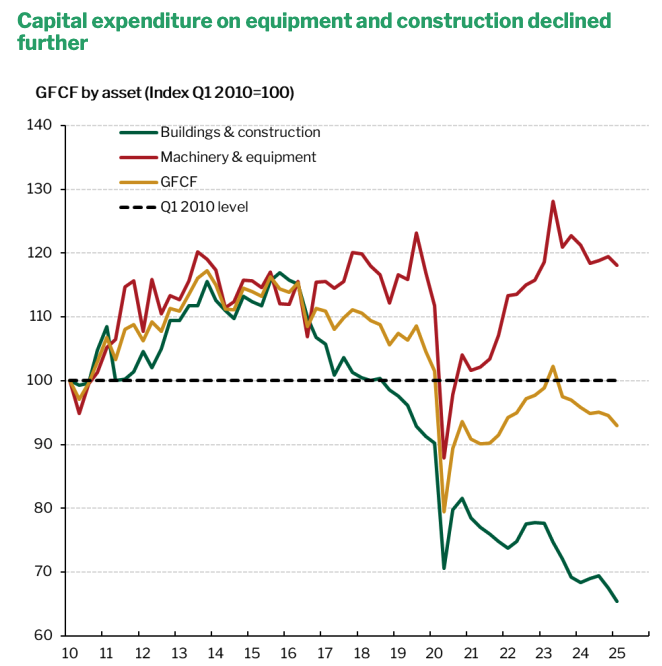
She pointed out that, currently, capital expenditure is mainly aimed at machinery and equipment in an attempt to find some efficiency in the system and bring costs down.
However, capital expenditure on buildings and construction as well as GFCF is down signifncatly and remains far below levels seen in 2010, when South Africa experienced an infrastrcuture boom in preparation for the FIFA World Cup.
This decline in infrastructure spending can be seen in the graphs below, courtesy of Weimar.