
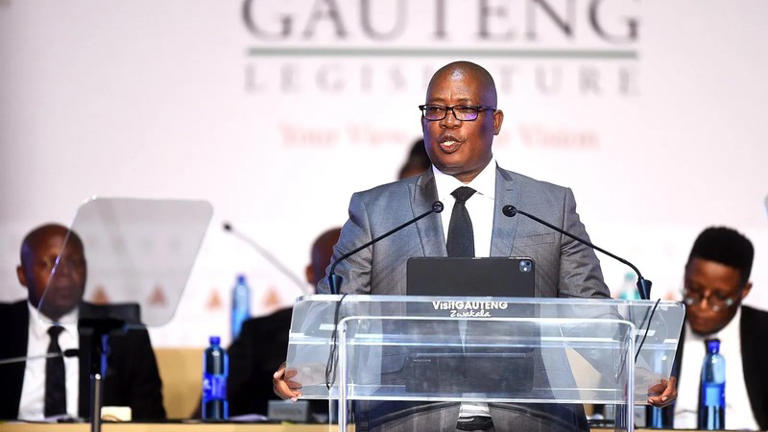
Gauteng Premier Panyaza Lesufi has blamed infrastructure failures, leaks and high-demand peaks for the water shortage crisis in Gauteng, and has announced a R760 million infrastructure upgrade in the City of Johannesburg, which has been hard hit by outages.
Lesufi made the remarks during his State of the Province Address (SOPA) at the Nasrec Expo Centre in Johannesburg on Monday night.
Service delivery across the province remains under strain, with many townships and informal settlements grappling with water shortages, recurring power outages, crime and deteriorating roads.
Parts of Johannesburg have been without water for days, affecting residents and forcing small businesses to dig deep into their already strained pockets to continue operating.
The city has long faced water supply challenges, with residents frequently left without running water.
Recently, frustrated residents in Midrand, one of the hardest-hit areas, took to the streets last month after being without water for more than 10 days.
The City of Johannesburg receives bulk water from Rand Water, which is distributed by its municipal entity, Joburg Water.
Lesufi said the latest crisis began on January 27, 2026, when an explosion at a Rand Water plant disrupted supply.
“After the explosion, fire hit our transmission machines, followed by a huge burst pipe,” he said.
“Immediately thereafter, our water supply was deeply affected. We then went into emergency mode. The area affected by the explosion was rectified within 72 hours, the fire extinguished, and the burst pipe repaired.”
However, reservoir levels were severely affected, prolonging the shortages.
The situation prompted President Cyril Ramaphosa to instruct Water and Sanitation Minister Pemmy Majodina and Cooperative Governance and Traditional Affairs Minister Velenkosini Hlabisa to urgently attend to Johannesburg’s water crisis instead of attending the State of the Nation Address (SONA).
Lesufi said the province’s water emergency team issued a proclamation allowing Rand Water to extract additional water from the Vaal River Integrated Water System.
He acknowledged that Midrand was the first suburban area to be severely affected but said water has now been fully restored there and in surrounding areas.
In Soweto, he said progress had been made except in Meadowlands Zones 3 and 4 and areas supplied by the Doornkop reservoir. Engineers are working to resolve the remaining issues.
According to him, water has also been restored in Kagiso and surrounding areas on the West Rand, he said.
He said supply is largely stable in Ekurhuleni, except in Bedfordview, Tsakane and parts of Kwa-Thema, as well as in Tshwane, Sedibeng and the West Rand.
Lesufi said some areas may experience low pressure at night because of night-time throttling, a measure used to reduce pressure and allow the system to recover.
Affected areas include Kensington, Bezuidenhout Valley, Bruma and Berea.
He said areas supplied through the Commando system and the Brixton Towers continue to experience instability, while challenges remain in parts of Westdene, Coronationville, Sophiatown, Melville, Emmarentia and sections of Doornkop.
Lesufi said a phased R760 million infrastructure investment programme is underway in Johannesburg to provide a permanent solution.
He said the construction of a new ground reservoir and water tower in Brixton is expected to be operational by Saturday.
An emergency booster pumping station will come online next week. A 5-kilometre pipeline, expected to be completed by the end of the year, forms part of the long-term solution.
He said the national government is assisting efforts to improve water infrastructure in Hammanskraal, Bronkhorstspruit, Kokosi, Fochville and Kwa-Thema.
“The challenge is not water availability, but the interruptions caused by infrastructure failures, leaks and high-demand peaks,” Lesufi said.
He said the province is expanding water infrastructure to prepare for additional supply from the Lesotho Highlands Water Project to strengthen long-term water security.
The premier said to avoid future sporadic shortages, the province, municipalities and national government have prioritised investment in water storage.
He added that in Midrand, a new 20 million-litre storage facility is under construction, with private developers contributing an additional 10 million litres.
Similar investments are underway in Ekurhuleni, Tshwane and the West Rand, Lesufi said.
“Even though we are making good progress, the water challenges in our province need constant monitoring and support,” he added.