
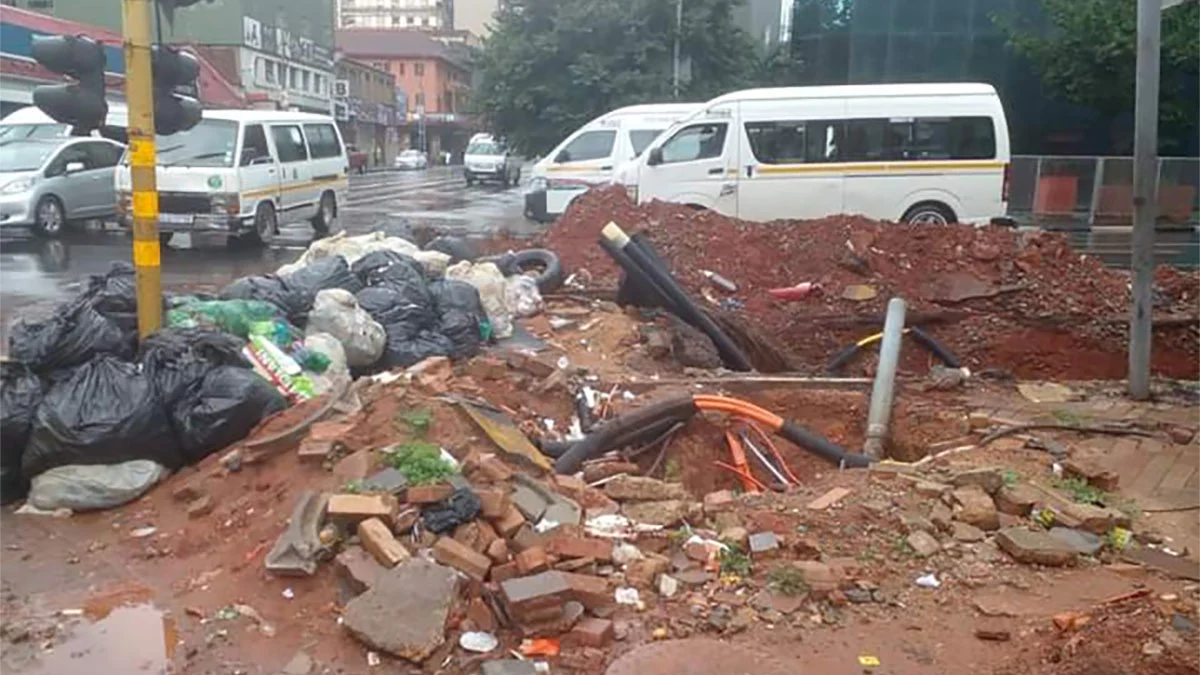
South Africa’s infrastructure is on the edge of collapse and is increasingly one of the reasons why the local economy cannot grow.
Apart from the buildup to the 2010 FIFA World Cup, South Africa’s infrastructure has been poorly maintained, and little expansion has taken place to accommodate a growing population.
As a result, much of the country’s infrastructure is not fit for the future and is heading towards the end of its design life.
Apart from limiting the movement of goods and people, deteriorating infrastructure exaggerates the impact of catastrophic weather events.
This results in exaggerated insurance claims, rising coverage costs, and, in some cases, a reduction in coverage from insurers.
Stanlib chief economist Kevin Lings identified the country’s collapsing infrastructure as one of the major reasons behind its stagnant economic growth over the past decade.
Apart from the short-term boost from constructing infrastructure, it also makes South Africans more productive and ensures companies can get their products to market.
“The first major problem South Africa has currently is that we have messed up the infrastructure, like big time,” Lings said at the 2025 Morningstar Investment Conference.
“I am not talking about potholes. I am talking about a proper decline in the quality of major infrastructure in South Africa, resulting in power outages and water shortages.”
Lings explained that ten years ago South Africa achieved a C rating from the South African Institure of Civil Engineers (SAICE) in its five-year infrastructure report.
In the latest report, the country is rated a D, which means that its infrastructure is at risk of failure in the coming years and is drifting towards the lowest rating of E, which means infrastructure is no longer fit for purpose.
A D rating indicates that infrastructure is not coping with normal demand and is poorly maintained, with it being increasingly likely that the public will be subjected to severe inconvenience and danger.
“Would you be happy to take home a D on your report card? Some people might, but generally no. It is a poor rating,” Lings said.
South Africa in deep trouble

South Africa’s collapsing infrastructure is not only endangering people but also posing a serious risk to the local economy.
Lings said infrastructure is the base of any economy, effectively enabling people and goods to flow and commerce to occur.
“A lot of our stuff now is at risk of failure. There is only one A-rated piece of infrastructure in South Africa, which is the Gautrain. This means there are a lot of things that are broken,” Lings said.
“There is quite a lot of stuff that is E-rated, including water and sanitation, various parts of our railways, and some of our roads.”
This effectively prevents the economy from experiencing any meaningful growth, as the basic resources needed for that cannot be supplied to businesses.
“Here is the question: Can you grow the economy at 4%? Can you grow South Africa’s economy at 4%? Could we achieve that? No,” Lings said.
“As you try and grow faster, at any rate, you will run out of things. You will run out of electricity. You will run out of water. Run out of rail capacity. Run out of port capacity.”
Despite not experiencing load-shedding for any of the past 100 days, South Africa’s electricity demand still exceeds supply.
The country simply does not have the required capacity to fuel future growth, with any additional economic activity likely to tip South Africa into load-shedding.
“The current infrastructure is what we call a binding constraint on the economy. It limits the maximum growth rate you can achieve,” Lings said.
“And that is very low right now in South Africa. So, going forward, to grow the economy, you have to fix the country’s infrastructure.”
“This is not an if, a but, or a maybe. You have to fix the infrastructure. It is not a choice anymore for South Africa. It has to be done.”